
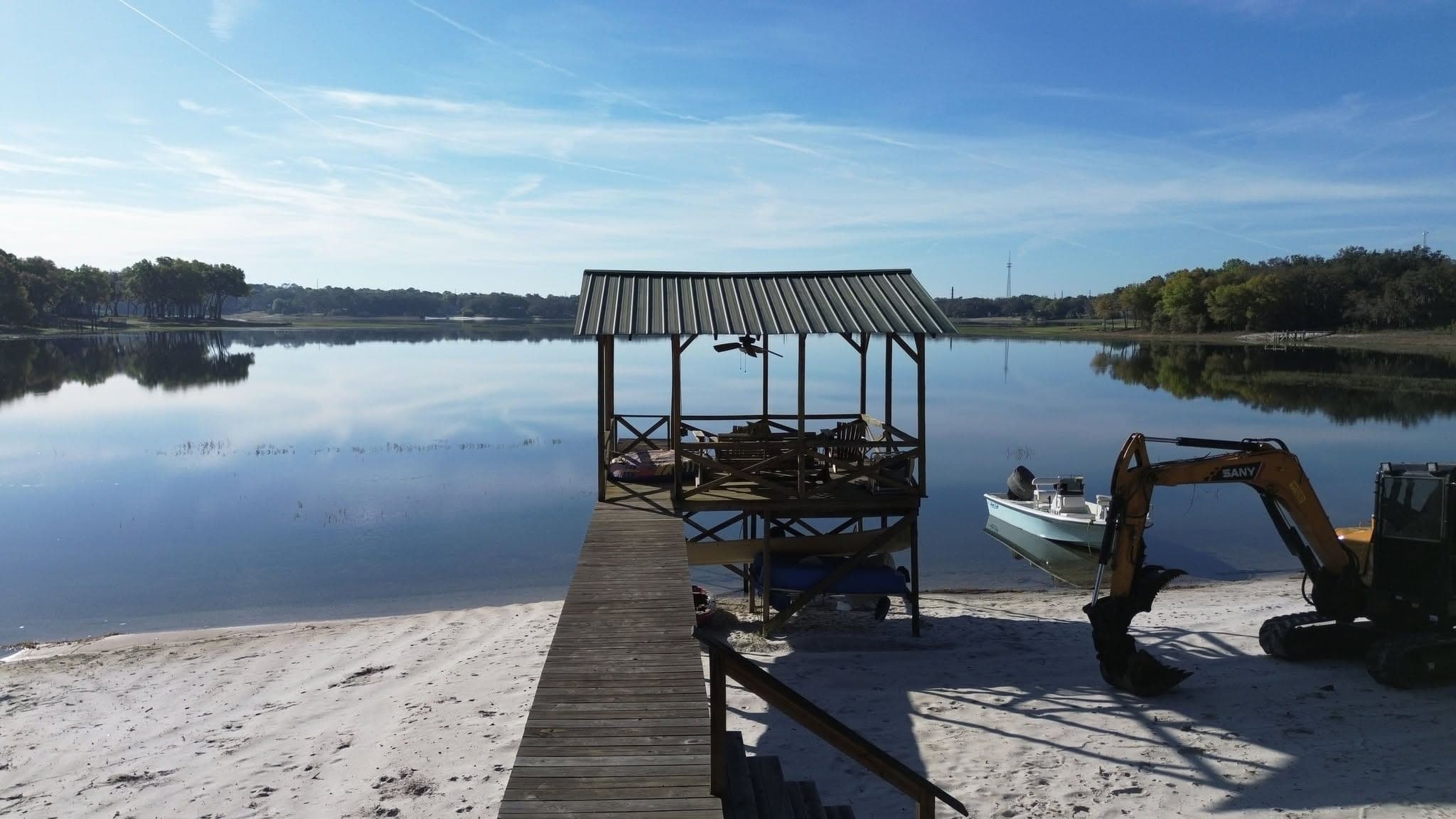
Dock Building in Northeast Florida
Docks, boathouses and boat lifts engineered for the water body they actually sit in.
A dock is a structure standing in the one place a building is never supposed to be. Everything about how it's built follows from the water it's in: pile depth follows the bottom material, framing follows the wave and wake energy, hardware follows whether the water is fresh or brackish, and deck height follows how far the level moves between a wet year and a dry one.
We build docks to the site, not to a catalog. That starts with probing the bottom to find bearing, and it ends with hardware chosen for the actual water chemistry — because galvanized fasteners in brackish water fail in a fraction of the time the same dock would last on a freshwater lake.
What's included
01
Site and bottom assessment
Water depth, bottom material and seasonal level range measured, because pile depth is determined by where bearing actually is — not by a standard.
02
Permitting and agency coordination
Water management district, state submerged-lands and Army Corps authorizations where required, plus local building permits.
03
Pile installation
Piles jetted or driven to bearing and cut to a consistent elevation, with the pattern set for the loads the structure will actually see.
04
Framing and decking
Marine-grade framing and decking, fastened with hardware rated for the water chemistry, and built with drainage and expansion accounted for.
05
Boat lifts and boathouses
Lift installation sized to vessel weight, and covered slips or boathouses where the structure and permitting allow.
06
Access, safety and utilities
Shoreline transition, handrails, steps and ladders, plus power and lighting run to code for a wet location.
How the work runs
01
Water and shoreline visit
We probe the bottom, measure depth at the intended slip, and look at the shoreline transition. Photos are not enough for this.
02
Design to the water body
Layout, length, height and structure designed to the level range, wake exposure and bottom conditions specific to your frontage.
03
Permitting
Applications to whichever agencies have jurisdiction over your shoreline. This is often the longest phase and we tell you that up front.
04
Pile installation
Barge or land-based pile setting, driven or jetted to bearing and verified before framing begins.
05
Structure and decking
Frame, deck, and any lift or covered structure installed and secured.
06
Finish and handover
Railings, ladders, cleats, lighting and electrical, then a walkthrough with maintenance guidance for your specific water conditions.
What actually drives the cost
- Distance to usable water depth
- On a shallow, gradually sloping bottom you may need eighty feet of walkway to reach four feet of water. Length is the primary cost driver, and it is set by your bottom, not by preference.
- Bottom material and pile depth
- Sand bottoms give bearing quickly. Organic muck can take piles twice as deep to find it. This is why an honest estimate requires probing the bottom first.
- Fresh versus brackish water
- Brackish water requires higher-grade hardware and different material choices throughout. It is a genuinely different structure, and it costs more.
- Permitting jurisdiction
- A small freshwater lake dock and an Intracoastal dock requiring Corps authorization differ by months of timeline and by real permitting cost.
- Lift capacity and covered structure
- A boat lift's rating and the pile pattern supporting it scale with vessel weight. A covered slip adds a roof structure with its own wind-load requirements.
Dock Building by area
We work across 7 counties from our base in Keystone Heights. Every locality below has its own page covering the conditions specific to building there.
Duval County
- Dock Building in Jacksonville
- Dock Building in Arlington
- Dock Building in Mandarin
- Dock Building in Oceanway
- Dock Building in Jacksonville Beach
- Dock Building in Atlantic Beach
- Dock Building in Riverside
- Dock Building in San Marco
- Dock Building in Avondale
- Dock Building in Neptune Beach
- Dock Building in Ortega
St. Johns County
- Dock Building in Fruit Cove
- Dock Building in Nocatee
- Dock Building in Julington Creek
- Dock Building in Palm Valley
- Dock Building in St. Johns
- Dock Building in St. Augustine
- Dock Building in St. Augustine Beach
- Dock Building in Switzerland
- Dock Building in Ponte Vedra Beach
- Dock Building in Vilano Beach
- Dock Building in Elkton
- Dock Building in Hastings
Related services
Seawalls & Bulkheads
Shoreline stabilization built to stop the erosion that's already taking your yard.
Land Clearing
Clearing, grading, driveways and drainage that get a property ready to build on.
Custom Home Building
Ground-up custom homes, from land clearing through the final walkthrough, with one builder accountable the whole way.
Dock Building questions
Do I need a permit to build a dock?
Almost always, and often from more than one agency. Depending on the water body it can involve the water management district, the state, the Army Corps and your county. We handle the applications.
How long does dock permitting take?
From a few weeks on a small private freshwater lake to several months where federal authorization is required. We'll tell you which category your water is in on the first visit.
How deep do the piles go?
As deep as it takes to reach bearing. That's why we probe the bottom before quoting — a sand bottom and an organic bottom on the same lake need very different pile lengths.
What decking material lasts longest here?
It depends on the water and the sun exposure. We'll walk you through pressure-treated, composite and hardwood options with honest lifespans for your specific conditions rather than a blanket recommendation.
Can you repair my existing dock instead of replacing it?
Often, yes. If the piles are sound the decking and framing can be rebuilt on them. If the piles are gone, repair is money spent on a structure with a short remaining life.
Can you install a boat lift on an existing dock?
If the pile pattern and structure will carry the load, yes. Frequently the existing piles weren't set for lift loads and additional piles are required.
What maintenance does a dock need?
Annual hardware inspection, fastener checks at the waterline, and cleaning appropriate to the water. Brackish-water docks need attention notably more often than freshwater ones.