
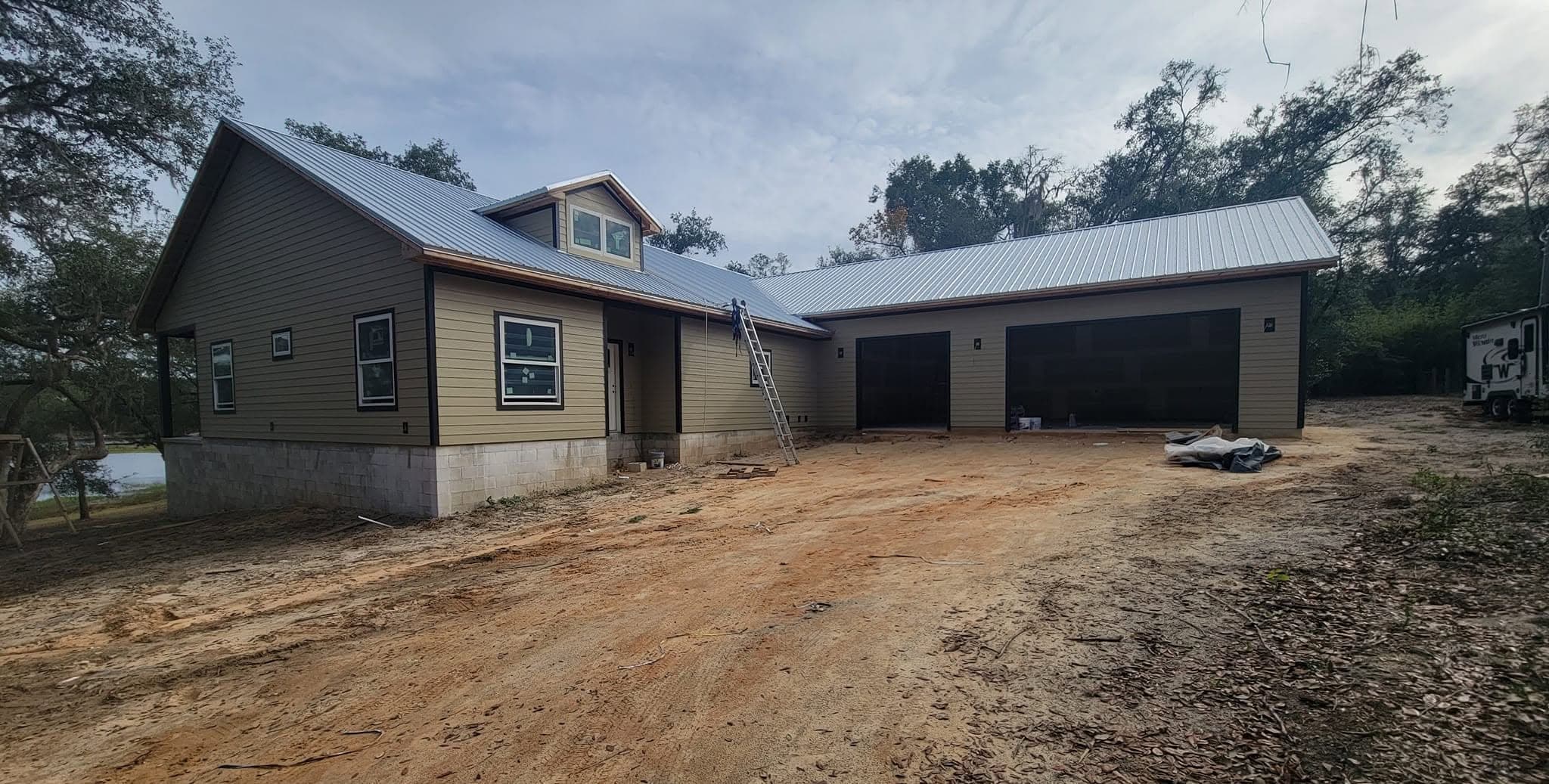
Land Clearing in Northeast Florida
Clearing, grading, driveways and drainage that get a property ready to build on.
Site work is where a build's budget is either protected or destroyed, and it happens before anything visible gets built. Clearing the wrong trees, building a pad at the wrong elevation, or routing water toward a neighbor instead of away from the house are all mistakes that are cheap to avoid and expensive to correct.
We approach a raw parcel by finding where water goes first, then where the building should sit, then what has to come out to make that work. Frequently that means clearing less than the owner expected — mature canopy is worth real money and takes decades to replace.
What's included
01
Survey and drainage review
Existing grade, flow direction, wetland flags and setbacks established before a machine moves, so the plan works with the site instead of against it.
02
Selective clearing
Underbrush and designated trees removed, with specimen trees protected — including root zones, not just trunks.
03
Stump and debris handling
Grinding, hauling or permitted on-site processing, with the disposal method agreed before work starts because it affects cost significantly.
04
Grading and pad construction
Building pad built up in compacted lifts to the required elevation, with density testing where the engineering calls for it.
05
Driveways and access
Base rock, crowning and culverts sized to actually pass water — the difference between a driveway that lasts and one that ruts every wet season.
06
Drainage and stabilization
Swales, culverts and retention as required, then seed or sod so the disturbed ground stops eroding.
How the work runs
01
Walk the property
We walk it with you, look at the low spots, the canopy and the access, and talk about what you actually want to keep.
02
Plan and permits
Clearing and grading permits, tree removal approval where local ordinance requires it, and wetland delineation where applicable.
03
Clearing
Underbrush and designated trees removed, protected trees fenced at the drip line before equipment arrives.
04
Stumps and debris
Stump removal and debris handled by the agreed method, with the site left workable rather than rutted.
05
Grading and pad
Cut and fill balanced where possible, pad built in lifts and compacted, and drainage features cut.
06
Access and stabilization
Driveway base placed, culverts set, and disturbed areas stabilized so the first heavy rain doesn't undo the work.
What actually drives the cost
- Density, not acreage
- Machine hours track how thick the vegetation is, not how many acres are on the deed. Five open acres and five acres of dense scrub oak are entirely different jobs.
- Debris disposal method
- Hauling off site is priced by the load. Permitted on-site burning or grinding is often cheaper but is not allowed everywhere. This choice moves the number substantially.
- Fill volume
- If the pad needs to come up two feet, that's a large volume of imported material plus compaction. Whether fill can be balanced on site is the biggest single variable.
- Access and haul distance
- A parcel with no road frontage or a long, soft approach costs more to work simply because getting equipment and material in and out takes longer.
- Wet season timing
- Site work in the dry season is faster and cheaper. Where the schedule allows it, timing the dirt work is a genuine cost saving.
Land Clearing by area
We work across 7 counties from our base in Keystone Heights. Every locality below has its own page covering the conditions specific to building there.
Clay County
- Land Clearing in Oakleaf Plantation
- Land Clearing in Fleming Island
- Land Clearing in Lakeside
- Land Clearing in Bellair-Meadowbrook Terrace
- Land Clearing in Middleburg
- Land Clearing in Orange Park
- Land Clearing in Green Cove Springs
- Land Clearing in Lake Asbury
- Land Clearing in Doctors Inlet
- Land Clearing in Keystone Heights
- Land Clearing in Lake Geneva
- Land Clearing in Penney Farms
Duval County
- Land Clearing in Jacksonville
- Land Clearing in Arlington
- Land Clearing in Mandarin
- Land Clearing in Oceanway
- Land Clearing in Jacksonville Beach
- Land Clearing in Atlantic Beach
- Land Clearing in Riverside
- Land Clearing in San Marco
- Land Clearing in Avondale
- Land Clearing in Neptune Beach
- Land Clearing in Ortega
- Land Clearing in Baldwin
St. Johns County
- Land Clearing in Fruit Cove
- Land Clearing in Nocatee
- Land Clearing in Julington Creek
- Land Clearing in Palm Valley
- Land Clearing in St. Johns
- Land Clearing in St. Augustine
- Land Clearing in World Golf Village
- Land Clearing in St. Augustine Beach
- Land Clearing in Switzerland
- Land Clearing in Ponte Vedra Beach
- Land Clearing in Vilano Beach
- Land Clearing in Elkton
- Land Clearing in Hastings
Alachua County
- Land Clearing in Gainesville
- Land Clearing in Alachua
- Land Clearing in Newberry
- Land Clearing in High Springs
- Land Clearing in Hawthorne
- Land Clearing in Archer
- Land Clearing in Waldo
- Land Clearing in Micanopy
- Land Clearing in Melrose
- Land Clearing in La Crosse
- Land Clearing in Earleton
- Land Clearing in Windsor
Related services
Custom Home Building
Ground-up custom homes, from land clearing through the final walkthrough, with one builder accountable the whole way.
Pole Barns & Metal Buildings
Post-frame and steel-frame barns, shops and equipment buildings engineered for Florida wind loads.
Seawalls & Bulkheads
Shoreline stabilization built to stop the erosion that's already taking your yard.
Land Clearing questions
Do I need a permit to clear my own land?
Usually yes, at least for grading and often for tree removal. Several jurisdictions in our area have tree ordinances with mitigation requirements. We confirm before clearing, not after.
How much does it cost to clear an acre?
Per-acre pricing is close to meaningless because vegetation density and debris disposal drive the cost, not area. We price after walking it — anyone quoting per acre sight unseen is guessing.
Should I clear the whole lot?
Almost never. Mature trees add real value, provide shade that lowers cooling costs, and cannot be replaced in a lifetime. We usually recommend clearing less than owners initially ask for.
What happens to the stumps?
Ground, hauled or processed on site depending on your jurisdiction and preference. Burying stumps on a building pad is not acceptable — they decompose and the pad settles.
How do I know if my land has wetlands?
A formal delineation by an environmental consultant is the only reliable answer. Standing water is a hint, not a determination, and building on undelineated wetland is a serious problem.
Can you fix my driveway so it stops washing out?
Yes — usually a matter of proper base material, a real crown, and correctly sized culverts. Most failing driveways are drainage problems rather than surface problems.
How long is site work good for before building?
A stabilized pad holds for a while, but bare disturbed ground erodes. If there's a long gap before construction, we stabilize it accordingly.