
Seawalls & Bulkheads in Northeast Florida
Shoreline stabilization built to stop the erosion that's already taking your yard.
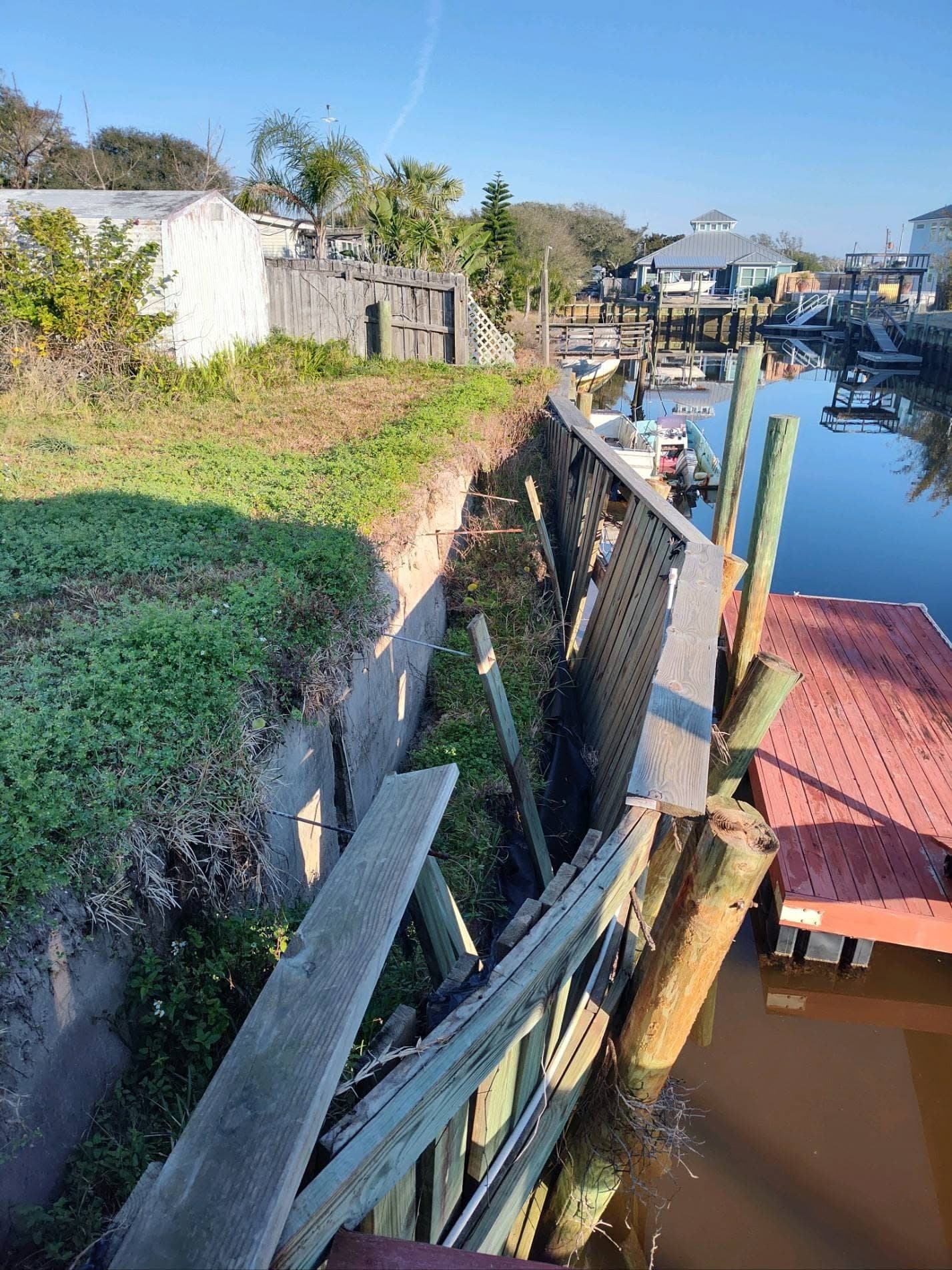
Seawalls almost never fail at the face. They fail behind it — soil washes out through a failed joint or an unfiltered weep, the backfill loses volume, the tiebacks lose their grip, and then the wall leans. By the time a wall is visibly tilting, the problem has been running for years underground.
That's why we build the drainage and the anchoring as the primary structure and treat the wall face as the visible part of it. Filter fabric behind the panels, weeps that actually relieve hydrostatic pressure, deadmen or helical anchors sized to the retained height, and backfill placed in lifts and compacted rather than dumped.
What's included
01
Shoreline and failure assessment
Retained height, soil type, water action and the existing wall's actual failure mode identified — repairing the wrong thing is the most common waste on this work.
02
Permitting
Water management district, state submerged-lands and Army Corps authorizations where jurisdiction applies, plus local permits.
03
Wall installation
Vinyl, composite, concrete or steel sheet pile driven to embedment depth appropriate to the retained height and soil.
04
Anchoring system
Tiebacks to deadmen or helical anchors, sized and spaced to the load, so the wall is held rather than just standing.
05
Drainage and filtration
Filter fabric, drainage stone and weep systems that relieve pressure without letting your yard escape through them.
06
Cap, backfill and restoration
Concrete cap, backfill placed in compacted lifts, and the shoreline and lawn restored to a finished condition.
How the work runs
01
Shoreline inspection
We look at the wall, the ground behind it, and the water in front of it. Sinkholes in the lawn and gaps at the joints tell the real story.
02
Design and engineering
Retained height, soil and water conditions drive embedment depth and anchor design. Where required, this is engineered and sealed.
03
Permitting
Applications to the agencies with jurisdiction. Shoreline armoring is regulated work and the timeline is real.
04
Demolition and installation
Existing wall removed or left in place as a form where appropriate, then new sheet pile driven to design embedment.
05
Anchoring and drainage
Tiebacks installed and tensioned, filter and drainage system placed, and backfill compacted in lifts.
06
Cap and restoration
Cap poured, shoreline graded and stabilized, and the site restored so the finished work looks like it belongs there.
What actually drives the cost
- Retained height
- Embedment depth and anchor requirements scale with how much soil the wall is holding back. A four-foot wall and a seven-foot wall are not the same structure at all.
- Access
- Whether equipment can reach the shoreline by land or the work has to be done from a barge changes the cost substantially, and it is determined by your lot, not by us.
- Soil and existing failure
- If soil behind the wall has already washed out, the void has to be filled and compacted. That is real volume, and it is not visible from the water side.
- Material choice
- Vinyl sheet pile, composite, concrete and steel differ in cost, lifespan and appearance. The right one depends on retained height, water chemistry and exposure.
- Permitting scope
- Repair in the same footprint is a shorter and cheaper approval than a new wall or one moved waterward. Where possible, staying in the existing line saves months.
Seawalls & Bulkheads by area
We work across 7 counties from our base in Keystone Heights. Every locality below has its own page covering the conditions specific to building there.
Clay County
- Seawalls & Bulkheads in Fleming Island
- Seawalls & Bulkheads in Lakeside
- Seawalls & Bulkheads in Middleburg
- Seawalls & Bulkheads in Orange Park
- Seawalls & Bulkheads in Green Cove Springs
- Seawalls & Bulkheads in Lake Asbury
- Seawalls & Bulkheads in Doctors Inlet
- Seawalls & Bulkheads in Keystone Heights
- Seawalls & Bulkheads in Lake Geneva
- Seawalls & Bulkheads in Penney Farms
Duval County
- Seawalls & Bulkheads in Jacksonville
- Seawalls & Bulkheads in Arlington
- Seawalls & Bulkheads in Mandarin
- Seawalls & Bulkheads in Oceanway
- Seawalls & Bulkheads in Jacksonville Beach
- Seawalls & Bulkheads in Atlantic Beach
- Seawalls & Bulkheads in Riverside
- Seawalls & Bulkheads in San Marco
- Seawalls & Bulkheads in Avondale
- Seawalls & Bulkheads in Neptune Beach
- Seawalls & Bulkheads in Ortega
St. Johns County
- Seawalls & Bulkheads in Fruit Cove
- Seawalls & Bulkheads in Nocatee
- Seawalls & Bulkheads in Julington Creek
- Seawalls & Bulkheads in Palm Valley
- Seawalls & Bulkheads in St. Johns
- Seawalls & Bulkheads in St. Augustine
- Seawalls & Bulkheads in St. Augustine Beach
- Seawalls & Bulkheads in Switzerland
- Seawalls & Bulkheads in Ponte Vedra Beach
- Seawalls & Bulkheads in Vilano Beach
- Seawalls & Bulkheads in Elkton
- Seawalls & Bulkheads in Hastings
Putnam County
- Seawalls & Bulkheads in Palatka
- Seawalls & Bulkheads in East Palatka
- Seawalls & Bulkheads in Crescent City
- Seawalls & Bulkheads in San Mateo
- Seawalls & Bulkheads in Interlachen
- Seawalls & Bulkheads in Satsuma
- Seawalls & Bulkheads in Pomona Park
- Seawalls & Bulkheads in Welaka
- Seawalls & Bulkheads in Georgetown
- Seawalls & Bulkheads in Florahome
Alachua County
- Seawalls & Bulkheads in Gainesville
- Seawalls & Bulkheads in Alachua
- Seawalls & Bulkheads in High Springs
- Seawalls & Bulkheads in Hawthorne
- Seawalls & Bulkheads in Waldo
- Seawalls & Bulkheads in Micanopy
- Seawalls & Bulkheads in Melrose
- Seawalls & Bulkheads in La Crosse
- Seawalls & Bulkheads in Earleton
- Seawalls & Bulkheads in Windsor
Related services
Dock Building
Docks, boathouses and boat lifts engineered for the water body they actually sit in.
Land Clearing
Clearing, grading, driveways and drainage that get a property ready to build on.
Custom Home Building
Ground-up custom homes, from land clearing through the final walkthrough, with one builder accountable the whole way.
Seawalls & Bulkheads questions
How do I know if my seawall needs replacing or just repair?
Check for lean, for voids in the lawn behind it, and for soil escaping at the joints. Cosmetic cracking in a plumb, well-drained wall is often repairable. Lean plus voids usually means the anchoring has failed and the wall is at the end of its life.
How long does a seawall last?
A properly anchored and drained wall in fresh water can run several decades. In brackish or high-energy water with poor drainage, walls fail far sooner — which is why the drainage detail matters more than the panel material.
Do I need a permit for seawall work?
Yes. Shoreline armoring is regulated, and depending on the water body it may involve the water management district, the state and the Army Corps as well as your county.
What are those pipes sticking out of a seawall?
Weeps. They relieve water pressure behind the wall. Behind each one there should be filter fabric and drainage stone so water gets out and soil does not. Weeps without filtration actively drain your yard into the water.
Can you build a new wall in front of the old one?
Sometimes, and it can be a good solution. But moving the wall waterward changes the permitting significantly, so we confirm what your jurisdiction allows before designing around it.
Will you restore the lawn afterward?
Yes. Backfill compacted in lifts, graded, and stabilized. A wall job that leaves a rutted shoreline isn't finished.
Can you do a living shoreline instead?
Where conditions and permitting support it, yes — and in low-energy water it can outperform a hard wall. In high-energy or steeply retained situations it is not a substitute, and we'll say so.