
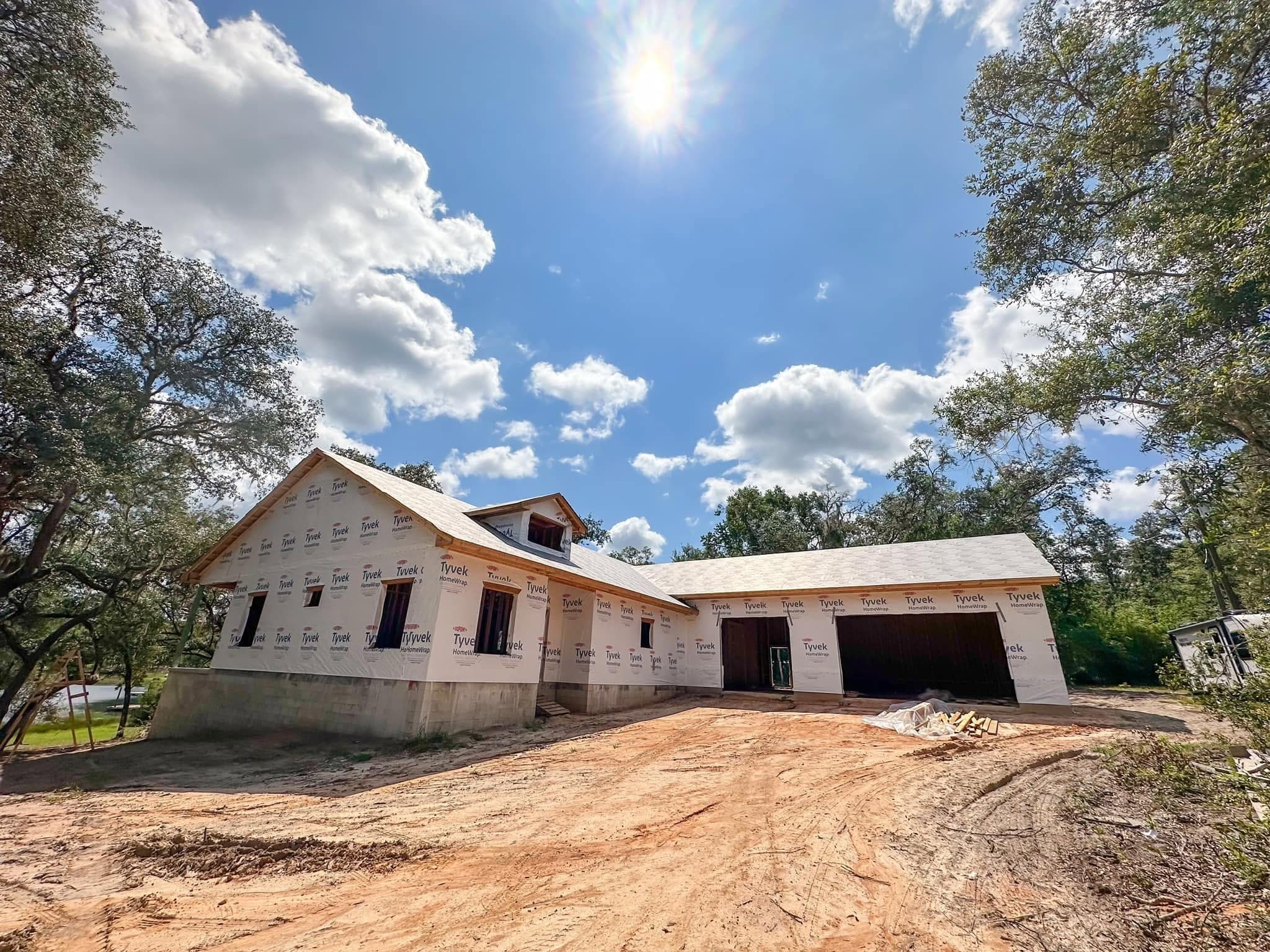
Bradford County · Northeast Florida
Drainage & Stormwater in Graham
Grading, swales, culverts and retention that move water away from the structure instead of toward it. Licensed and insured, Florida Certified Building Contractor CBC1265492.
- Away from the structure
- Positive fallAway from the structure
- Pipe sized to real storm flow
- SizedPipe sized to real storm flow
- Seeded or sodded before we leave
- StabilizedSeeded or sodded before we leave
Drainage & Stormwater for Graham property owners
Drainage & Stormwater in Graham starts with the property, not with a catalog. From SR-18 across to the Sampson River, Graham is territory we know. The work here tends to be rural acreage, barns and shops and single-family homes.
Before anything gets designed we look at what we're building on. Low, flat ground with poor natural drainage and a high seasonal water table, and Sampson River bottomland nearby that floods predictably in wet season.
What acreage in Graham demands
Around Graham the drainage problem is almost always the hardpan. Low, flat ground with poor natural drainage and a high seasonal water table. That means rain doesn't soak away, it sits — and a building set at natural grade sits in it. Sampson River bottomland nearby that floods predictably in wet season. The other half is the ditch-and-culvert network these areas depend on: when one culvert on a long driveway is undersized or crushed, everything upstream of it backs up, and that culvert is usually somebody's responsibility nobody has identified. County permitting, with septic and well approvals preceding any building permit.
The second local factor: a scatter of rural homes and farm buildings on large parcels. Any honest estimate for Graham accounts for that before it accounts for finishes.
The issuing office is Town of Graham and Bradford County. We confirm exactly what applies to your parcel before design, rather than discovering it at review.
That's the whole reason we walk Graham properties before quoting: the conditions above change the scope, and a number that ignores them isn't a number.
What drainage & stormwater in Graham covers
- Survey and flow mapping
- Grading and swales
- French drains and subsurface systems
- Culverts and driveway crossings
- Roof water routing
- Retention, outfall and stabilization
Signs it's time to call
These are the things owners tell us on the first call. If more than one sounds familiar, it's worth a look.
- Water stands in the same spot for more than a day after rain.
- The driveway ruts or washes out in the same place every wet season.
How we deliver drainage & stormwater in Graham
01
Walk it wet
02
Survey and design
03
Permitting and outfall approval
04
Earthwork
05
Pipe and structures
06
Stabilize and verify
What actually drives the cost
We won't quote a number sight unseen. These are the factors that move it, so you can see where your project is likely to land before we ever walk the property.
- Where the water can legally go
- The single biggest variable. A parcel with a ditch, easement or street inlet to discharge into is straightforward. One with nowhere to send water needs retention, and retention is volume, excavation and area.
- Surface versus subsurface
- Regrading and swales cost a fraction of a piped subsurface system. We recommend the cheaper one whenever the site will accept it, which is more often than people expect.
Serving Graham.
We do drainage work on rural property around Graham — driveway culverts sized to real flow, swales along long access drives, pad correction on buildings that flood, and ditch reconnection where the historic route has silted in. Rural acreage, barns and shops and single-family homes are common.
Graham sits in Bradford County, and we cover the surrounding communities on the same trips — Starke, Hampton, Brooker and Raiford are all inside our regular working radius from Keystone Heights.
- rural acreage
- barns and shops
- single-family homes
Other work we do in Graham
Land Clearing in Graham
Clearing, grading, driveways and drainage that get a property ready to build on.
Learn more →Excavation in Graham
Foundation, pond, utility and pad excavation on sites where the water table is close and the soil changes across the lot.
Learn more →Custom Home Building in Graham
Ground-up custom homes, from land clearing through the final walkthrough, with one builder accountable the whole way.
Learn more →Drainage & Stormwater near Graham
All areas we serve for drainage & stormwater →Drainage & Stormwater questions in Graham
My driveway washes out every wet season near Graham — what actually fixes it?
Usually a correctly sized culvert and a real crown, not more rock. Around Graham the recurring failure is a crossing too small for the flow the ditch carries, so water goes over the drive instead of under it. Sizing the pipe to the catchment fixes it permanently; regrading alone just resets the clock.
How much does drainage work cost in Graham?
Not without seeing the property, and any contractor who does is guessing. In Graham the biggest single variable is usually the site itself — low, flat ground with poor natural drainage and a high seasonal water table — which changes the scope before anything else does. We'll walk it and give you a real number.
Does drainage work in Graham need a permit?
Yes. Approvals run through Town of Graham and Bradford County. County permitting, with septic and well approvals preceding any building permit. We manage the applications and inspections; you should never be chasing a reviewer.
What's your availability for work in Graham?
Site visits in Graham are typically within a week or so. Start dates hinge on Town of Graham and Bradford County's review timeline, which we'll tell you honestly up front instead of promising a date we'd have to move.
Do you serve Graham and the surrounding area?
Yes. Graham is inside our regular service area from Keystone Heights, and we work throughout Bradford County — including Starke, Hampton and Brooker. Call (352) 478-6112 and we'll come look at the property.
Will drainage work fix a wet crawlspace or slab?
Frequently, because the source is usually roof water and surface flow arriving at the foundation. Where the problem is a high water table rather than surface water, drainage helps but is not the whole answer, and we'll say so rather than sell a system that underdelivers.
How long does drainage work take?
Most residential projects run a few days to two weeks. Permitting and outfall approval, where required, usually take longer than the construction does.
Ready to talk about drainage & stormwater in Graham?
Free consultations, straight answers, and one contractor accountable from the first walkthrough to the last punch item.