
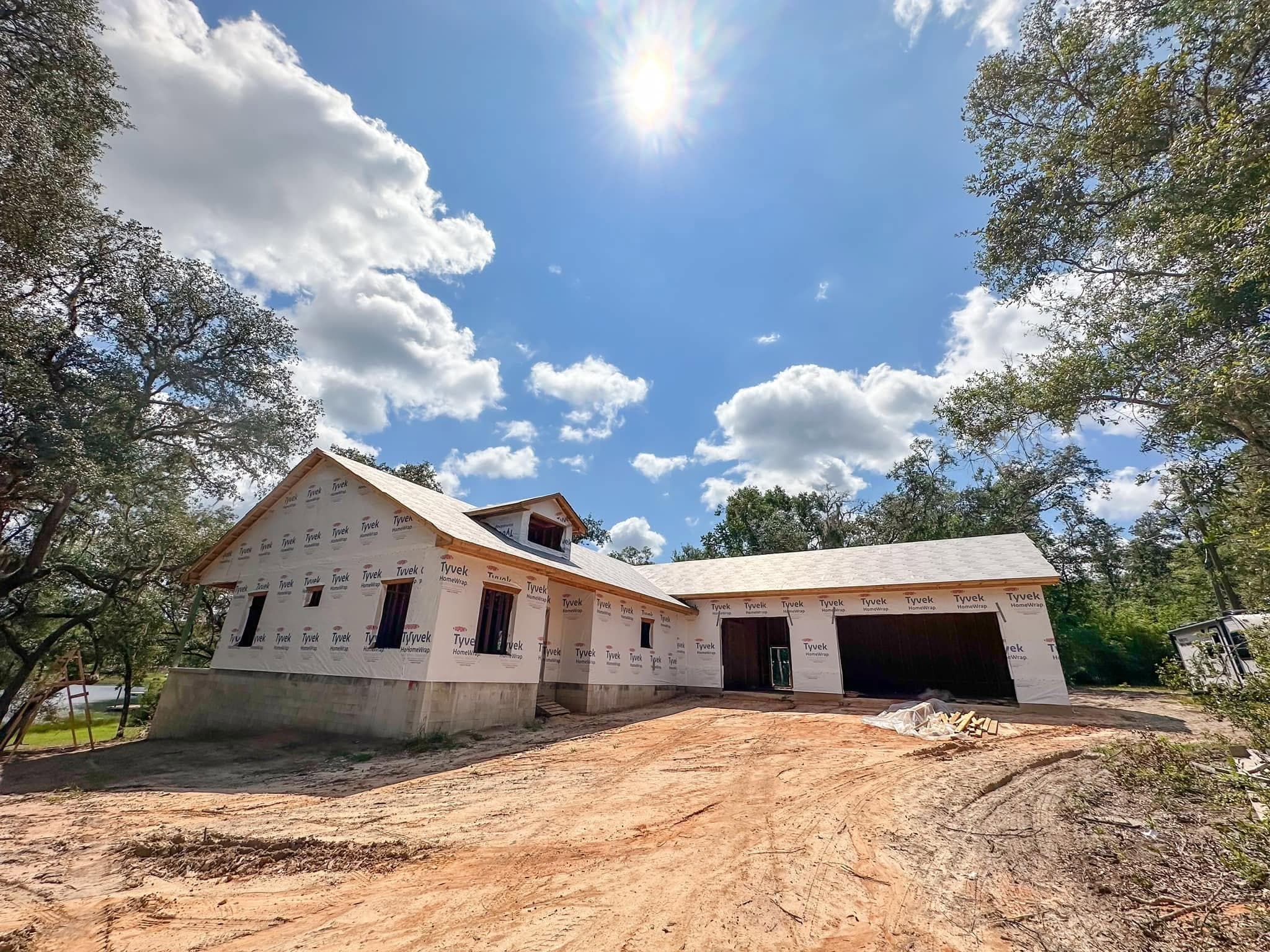
Bradford County · Northeast Florida
Drainage & Stormwater in Hampton
Grading, swales, culverts and retention that move water away from the structure instead of toward it. Licensed and insured, Florida Certified Building Contractor CBC1265492.
- Away from the structure
- Positive fallAway from the structure
- Pipe sized to real storm flow
- SizedPipe sized to real storm flow
- Seeded or sodded before we leave
- StabilizedSeeded or sodded before we leave
Drainage & Stormwater for Hampton property owners
Good drainage work in Hampton begins with an afternoon on the property. We cover the whole of Hampton: Hampton Lake, SR-18, and everything in between. The properties we work on in Hampton are mainly lakefront homes, small-town residential and detached shops.
Sandhill sand with good drainage, sloping toward the lake on the south side of town. A small shallow lake where seasonal level change exposes and re-submerges shoreline — dock structures need to work across a wide range. Those two facts explain most of the difference between a Hampton estimate and one from an hour inland.
Why Hampton lake property needs the right approach
Drainage around Hampton is rarely about ponding — the sand sees to that. Sandhill sand with good drainage, sloping toward the lake on the south side of town. That means water moves fast and takes soil with it, so the problem shows up as rills down a slope, a driveway cutting deeper every season, and sediment reaching the water. A small shallow lake where seasonal level change exposes and re-submerges shoreline — dock structures need to work across a wide range. Because the shoreline buffer is usually protected, the fix has to slow water down and spread it out well before it gets to the bank.
There's a second thing worth knowing about building in Hampton: small older homes on large lots, with room and demand for additions and outbuildings. So what fits Hampton is not automatically what fits the next community over.
Approvals in Hampton come from City of Hampton and Bradford County. Very small municipality where county building services handle most of the technical review. Sorting that out early is unglamorous and it is where schedules are won.
What that adds up to is a drainage work approach built around Hampton specifically: the site investigated before the design commits, materials chosen for the conditions they'll actually live in, and a schedule that reflects the real permitting timeline rather than an optimistic one.
Site conditions
What the public record says about Hampton
- Dominant soil
- Plummer-Plummer wet; poorly drained, group A/D· USDA NRCS
- Water table
- At or near the surface in the wet season· USDA NRCS
- Sinkhole reports
- 0 within 5 mi· Florida Geological Survey
- Water district
- Suwannee River Water Management District· SRWMD
- Flood zones
- A, AE, X (within 1 mile)· FEMA NFHL
- Springs nearby
- Lake Lowry Springs· Florida Geological Survey
Area data as of October 2026; your parcel is checked on site.
Plummer-Plummer wet is the mapped soil near Hampton, poorly drained. With the water at or near the surface in the wet season, drainage work here is scheduled around the rain, and dewatering is priced in rather than discovered.
FEMA A and AE zones sit within a mile of Hampton. Earthwork inside one can't raise flood levels for neighbours, so cut and fill are balanced on paper first.
Water leaving a Hampton property is the Suwannee River Water Management District's business. We check its thresholds before grading changes where the water goes.
What drainage & stormwater in Hampton covers
- Survey and flow mapping
- Grading and swales
- French drains and subsurface systems
- Culverts and driveway crossings
Signs it's time to call
These are the things owners tell us on the first call. If more than one sounds familiar, it's worth a look.
- There's a dark tide line or chalky efflorescence on the slab edge or the bottom course of block.
- Mulch and topsoil migrate toward the street after every storm.
What actually drives the cost
We won't quote Hampton work sight unseen, but here's one of the factors that moves the number most.
- How much fall you have
- Florida is flat. When a site has only inches of fall across a hundred feet, the design gets tighter and the workmanship has to be better. Both cost more than a site that drains itself.
Codes & permits
Codes and permits for drainage & stormwater in Hampton
- Local floodplain ordinanceFill in the floodplain
- Chapter 62-330, F.A.C.Environmental Resource Permit
- Rule 62-621.300(4), F.A.C.Construction stormwater (NPDES) permit
- §556.105, F.S.Sunshine 811 locate
Working in Hampton.
We do drainage work across Hampton — driveway crossings, swales that keep runoff away from the shoreline, and grading on lots that fall toward the water. Lakefront homes, small-town residential and detached shops are what we work on. The goal here is almost always slowing water down rather than piping it somewhere.
Because we're based in Keystone Heights, Hampton and its neighbors get worked together: Waldo, Starke, Graham and Keystone Heights are all on the same rounds.
- lakefront homes
- small-town residential
- detached shops
Drainage & Stormwater near Hampton
All areas we serve for drainage & stormwater →Drainage & Stormwater questions in Hampton
What is the soil like around Hampton?
USDA maps Plummer-Plummer wet as the dominant soil near Hampton: poorly drained, water table at or near the surface in the wet season. That's the area, not your lot; we confirm on site before pricing earthwork.
My Hampton lot drains fast — why do I still have a drainage problem?
Because sand drains vertically but runoff still travels across the surface, and on a slope toward the lake it carries soil with it. In Hampton the damage usually shows up as erosion and sediment rather than standing water, and the fix is slowing and spreading the flow rather than collecting it.
Why won't you quote drainage work in Hampton without seeing the property?
It depends on the site more than on the square footage. Sandhill sand with good drainage, sloping toward the lake on the south side of town, and a small shallow lake where seasonal level change exposes and re-submerges shoreline — dock structures need to work across a wide range, both of which move the number materially in Hampton. We quote after a walkthrough, free of charge.
What's the permitting process for drainage work in Hampton?
Yes for anything structural or involving systems. Permits come from City of Hampton and Bradford County, and there's a local wrinkle worth knowing: very small municipality where county building services handle most of the technical review. We handle the whole submittal.
When could you get out to look at a Hampton property?
Quickly for the walkthrough — Hampton is close enough to Keystone Heights that scheduling isn't the constraint. Permitting is, and we'll be straight with you about how long City of Hampton and Bradford County actually takes.
How far do you go from Keystone Heights — does that include Hampton?
Yes — Hampton is well inside the radius we work from Keystone Heights, as are Waldo, Starke and Graham. Give us a call at (352) 478-6112 and we'll set up a walkthrough.
Can't I just add topsoil to the low spot?
That moves the puddle rather than removing it. Water has to go somewhere, and filling the place it collects sends it to the next lowest point, sometimes the foundation. Fill only works as part of a plan that gives the water a route out.
Ready to talk about drainage & stormwater in Hampton?
Free consultations, straight answers, and one contractor accountable from the first walkthrough to the last punch item.