
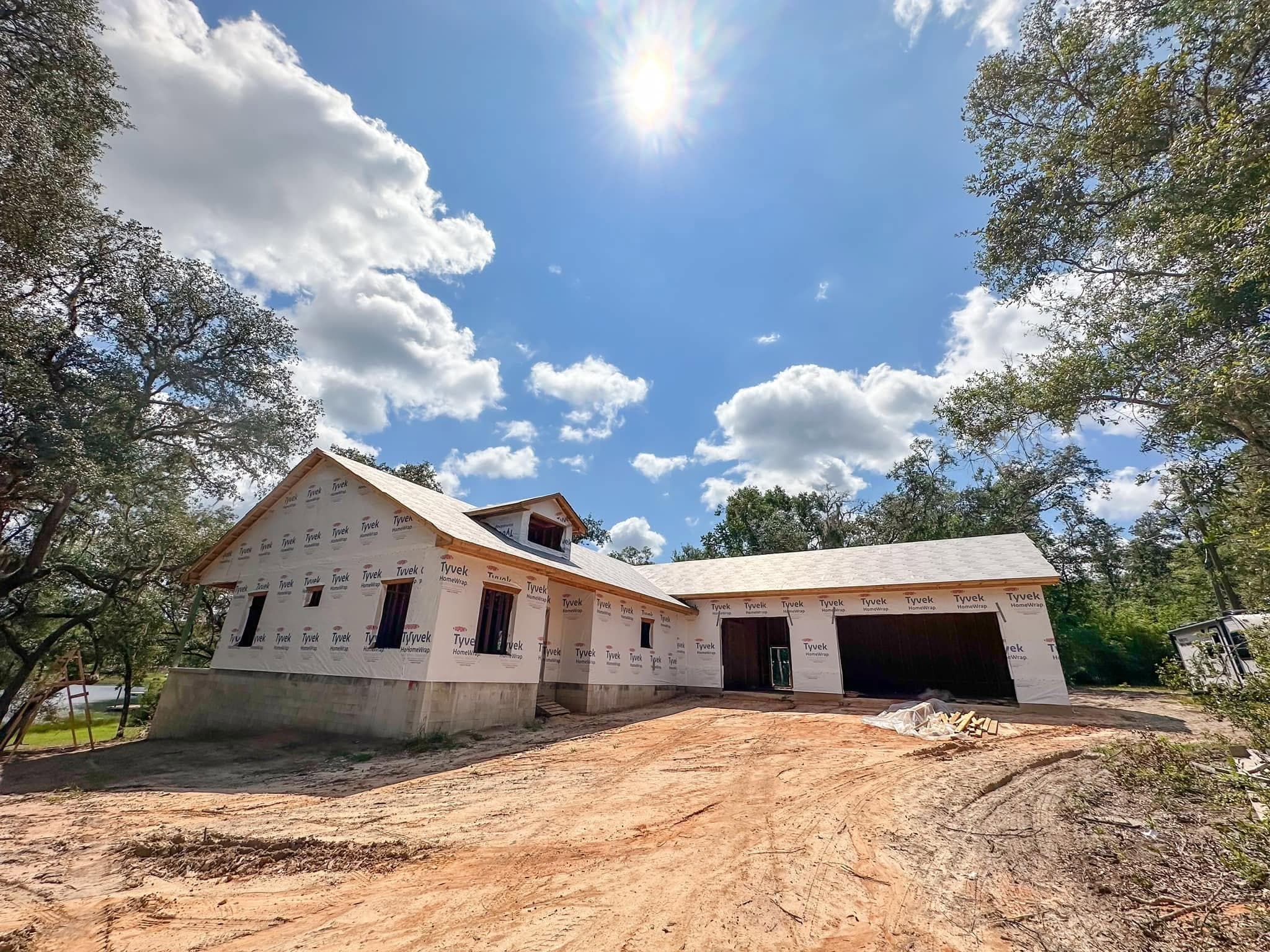
Clay County · Northeast Florida
Drainage & Stormwater in Lake Geneva
Grading, swales, culverts and retention that move water away from the structure instead of toward it. Licensed and insured, Florida Certified Building Contractor CBC1265492.
- Away from the structure
- Positive fallAway from the structure
- Pipe sized to real storm flow
- SizedPipe sized to real storm flow
- Seeded or sodded before we leave
- StabilizedSeeded or sodded before we leave
Drainage & Stormwater for Lake Geneva property owners
If you're looking at drainage work in Lake Geneva, local conditions matter more than most estimates admit. From Lake Geneva across to State Road 100, Lake Geneva is territory we know. The work here tends to be lakefront cottages, wooded homesites and boathouses and dock structures.
Before anything gets designed we look at what we're building on. Sandhill sand with a scrub-oak canopy, which means clearing decisions get made tree by tree rather than by the acre, and a spring-fed lake with a sand bottom and very little wave energy, so dock structures fail from wood rot and pile settlement long before they fail from water action.
Why Lake Geneva lake property needs the right approach
Drainage around Lake Geneva is rarely about ponding — the sand sees to that. Sandhill sand with a scrub-oak canopy, which means clearing decisions get made tree by tree rather than by the acre. That means water moves fast and takes soil with it, so the problem shows up as rills down a slope, a driveway cutting deeper every season, and sediment reaching the water. A spring-fed lake with a sand bottom and very little wave energy, so dock structures fail from wood rot and pile settlement long before they fail from water action. Because the shoreline buffer is usually protected, the fix has to slow water down and spread it out well before it gets to the bank.
The other factor specific to Lake Geneva: small older cottages on generous lots — the common project is doubling the house rather than replacing it. Any honest estimate for Lake Geneva accounts for that before it accounts for finishes.
The permitting picture: jurisdiction sits with Clay County Building Division. Unincorporated Clay County permitting, with St. Johns River Water Management District review for anything touching the shoreline. Knowing which office reviews what — and how long each actually takes — is part of what you're hiring us for.
So our drainage work in Lake Geneva runs in that order — understand the site, design to it, price the whole of it including the parts nobody enjoys paying for, then build.
Site conditions
Lake Geneva by the numbers
- Dominant soil
- Troup sand; well drained, group A· USDA NRCS
- Water table
- Deeper than 6½ feet· USDA NRCS
- Sinkhole reports
- 6 within 5 mi· Florida Geological Survey
- Water district
- St. Johns River Water Management District· SJRWMD
- Flood zones
- A, AE, X (within 1 mile)· FEMA NFHL
- Springs nearby
- Gold Head Branch, Lake Lowry Springs· Florida Geological Survey
Area data as of October 2026; your parcel is checked on site.
The ground near Lake Geneva is mapped as Troup sand, well drained. Sand like that moves easily and drains readily, but it caves. Every cut deeper than a few feet gets a planned slope or a box.
6 subsidence reports sit on file within 5 miles of Lake Geneva. In karst like this, drainage work that concentrates water or removes cover over a depression is done carefully, or not at all.
With A and AE zones mapped near Lake Geneva, fill or grading inside a flood zone can need compensating storage. Water pushed off one lot can't just land on the next.
What drainage & stormwater in Lake Geneva covers
- French drains and subsurface systems
- Culverts and driveway crossings
- Roof water routing
- Retention, outfall and stabilization
Signs it's time to call
These are the things owners tell us on the first call. If more than one sounds familiar, it's worth a look.
- There's a dark tide line or chalky efflorescence on the slab edge or the bottom course of block.
- Mulch and topsoil migrate toward the street after every storm.
What actually drives the cost
No two Lake Geneva jobs price the same. One of the factors that decides where yours lands:
- How much fall you have
- Florida is flat. When a site has only inches of fall across a hundred feet, the design gets tighter and the workmanship has to be better. Both cost more than a site that drains itself.
Codes & permits
Codes and permits for drainage & stormwater in Lake Geneva
- Local floodplain ordinanceFill in the floodplain
- FBC-Building 1803Geotechnical investigation
- Chapter 62-330, F.A.C.Environmental Resource Permit
- Rule 62-621.300(4), F.A.C.Construction stormwater (NPDES) permit
Serving Lake Geneva.
We do drainage work across Lake Geneva — driveway crossings, swales that keep runoff away from the shoreline, and grading on lots that fall toward the water. Lakefront cottages, wooded homesites and boathouses and dock structures are what we work on. The goal here is almost always slowing water down rather than piping it somewhere.
We're in Clay County constantly. Alongside Lake Geneva we regularly work Keystone Heights, Melrose, Earleton and Florahome, which keeps trip costs off your estimate.
- lakefront cottages
- wooded homesites
- boathouses and dock structures
Other work we do in Lake Geneva
Drainage & Stormwater near Lake Geneva
All areas we serve for drainage & stormwater →Drainage & Stormwater questions in Lake Geneva
What is the soil like around Lake Geneva?
USDA maps Troup sand as the dominant soil near Lake Geneva: well drained, water table deeper than 6½ feet. That's the area, not your lot; we confirm on site before pricing earthwork.
My Lake Geneva lot drains fast — why do I still have a drainage problem?
Because sand drains vertically but runoff still travels across the surface, and on a slope toward the lake it carries soil with it. In Lake Geneva the damage usually shows up as erosion and sediment rather than standing water, and the fix is slowing and spreading the flow rather than collecting it.
How much does drainage work cost in Lake Geneva?
Not without seeing the property, and any contractor who does is guessing. In Lake Geneva the biggest single variable is usually the site itself — sandhill sand with a scrub-oak canopy, which means clearing decisions get made tree by tree rather than by the acre — which changes the scope before anything else does. We'll walk it and give you a real number.
Who pulls the permit for drainage work in Lake Geneva?
Almost always. Jurisdiction sits with Clay County Building Division. Unincorporated Clay County permitting, with St. Johns River Water Management District review for anything touching the shoreline. That's our responsibility, not yours: applications, comment responses and inspections are all part of the contract.
What's your availability for work in Lake Geneva?
Site visits in Lake Geneva are typically within a week or so. Start dates hinge on Clay County Building Division's review timeline, which we'll tell you honestly up front instead of promising a date we'd have to move.
Do you serve Lake Geneva and the surrounding area?
Yes. Lake Geneva is inside our regular service area from Keystone Heights, and we work throughout Clay County — including Keystone Heights, Melrose and Earleton. Call (352) 478-6112 and we'll come look at the property.
French drain or regrading — which do I need?
Regrading if the site has enough fall to move water on the surface, because it is cheaper and far easier to maintain. A French drain when it doesn't. Anyone recommending a French drain before shooting elevations is selling pipe, not a solution.
Ready to talk about drainage & stormwater in Lake Geneva?
Free consultations, straight answers, and one contractor accountable from the first walkthrough to the last punch item.