
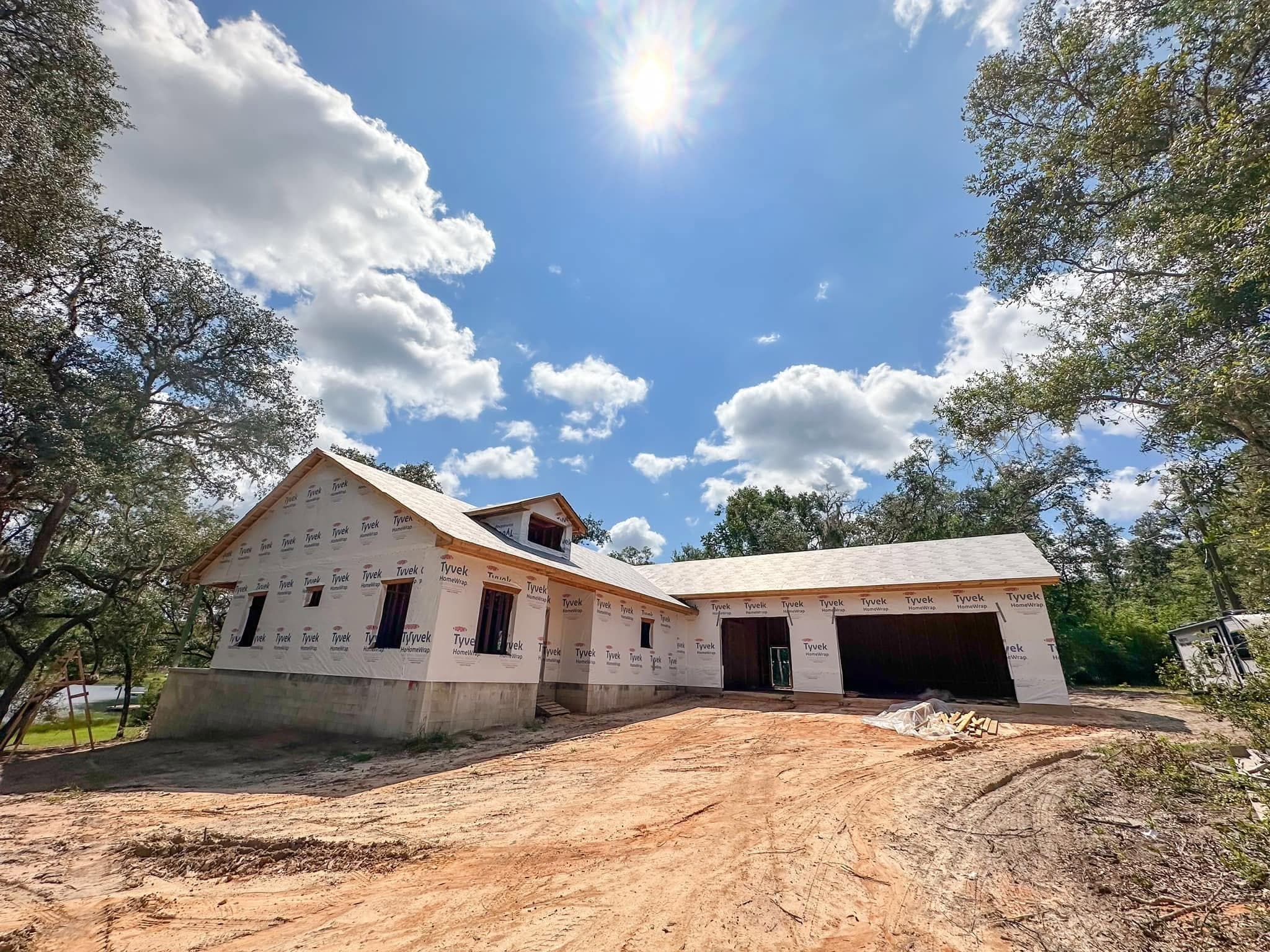
Alachua County · Northeast Florida
Drainage & Stormwater in Melrose
Grading, swales, culverts and retention that move water away from the structure instead of toward it. Licensed and insured, Florida Certified Building Contractor CBC1265492.
- Away from the structure
- Positive fallAway from the structure
- Pipe sized to real storm flow
- SizedPipe sized to real storm flow
- Seeded or sodded before we leave
- StabilizedSeeded or sodded before we leave
Drainage & Stormwater for Melrose property owners
We take on drainage work throughout Melrose, Alachua County. We cover the whole of Melrose: Lake Santa Fe, Melrose Bay, and everything in between. Around Melrose that generally means lakefront homes, historic frame houses and boathouses and docks.
What makes Melrose its own case is straightforward. Sandhill sand on the Trail Ridge, well-drained, with steep short banks down to the lake on many parcels, and on top of that, Lake Santa Fe and Little Santa Fe are large, clear sandhill lakes with meaningful fetch and multi-foot seasonal level swings.
Why Melrose lake property needs the right approach
Drainage around Melrose is rarely about ponding — the sand sees to that. Sandhill sand on the Trail Ridge, well-drained, with steep short banks down to the lake on many parcels. That means water moves fast and takes soil with it, so the problem shows up as rills down a slope, a driveway cutting deeper every season, and sediment reaching the water. Lake Santa Fe and Little Santa Fe are large, clear sandhill lakes with meaningful fetch and multi-foot seasonal level swings. Because the shoreline buffer is usually protected, the fix has to slow water down and spread it out well before it gets to the bank.
One more condition that shapes the work here: an unusual mix of 1880s-1920s historic frame houses and substantial modern lakefront customs. It changes what we expect to find once we start, and therefore what we're willing to quote before we do.
Permitting runs through Alachua, Putnam, Clay and Bradford county offices. Melrose sits at the corner of four counties, so establishing which jurisdiction actually issues the permit is genuinely the first step. Knowing which office reviews what — and how long each actually takes — is part of what you're hiring us for.
That's the whole reason we walk Melrose properties before quoting: the conditions above change the scope, and a number that ignores them isn't a number.
Site conditions
The ground, water and weather around Melrose
- Dominant soil
- Millhopper sand; moderately well drained, group A· USDA NRCS
- Water table
- About 57 inches down at its seasonal high· USDA NRCS
- Sinkhole reports
- 1 within 5 mi· Florida Geological Survey
- Water district
- Suwannee River Water Management District· SRWMD
- Flood zones
- A, AE, X (within 1 mile)· FEMA NFHL
Area data as of October 2026; your parcel is checked on site.
Millhopper sand (moderately well drained) is what the survey shows near Melrose, the water about 57 inches down at its seasonal high. Good enough to plan around; we still verify it on your lot.
FEMA A and AE zones sit within a mile of Melrose. Earthwork inside one can't raise flood levels for neighbours, so cut and fill are balanced on paper first.
Water leaving a Melrose property is the Suwannee River Water Management District's business. We check its thresholds before grading changes where the water goes.
What drainage & stormwater in Melrose covers
- Survey and flow mapping
- Grading and swales
- French drains and subsurface systems
- Culverts and driveway crossings
Signs it's time to call
These are the things owners tell us on the first call. If more than one sounds familiar, it's worth a look.
- The drainfield area stays soggy after the rest of the yard has dried out.
- Your neighbor's water arrives on your property, or yours arrives on theirs.
What actually drives the cost
No two Melrose jobs price the same. One of the factors that decides where yours lands:
- Where the water can legally go
- The single biggest variable. A parcel with a ditch, easement or street inlet to discharge into is straightforward. One with nowhere to send water needs retention, and retention is volume, excavation and area.
Codes & permits
Codes and permits for drainage & stormwater in Melrose
- Local floodplain ordinanceFill in the floodplain
- Chapter 62-330, F.A.C.Environmental Resource Permit
- Rule 62-621.300(4), F.A.C.Construction stormwater (NPDES) permit
- §556.105, F.S.Sunshine 811 locate
On the ground in Melrose.
We do drainage work across Melrose — driveway crossings, swales that keep runoff away from the shoreline, and grading on lots that fall toward the water. Lakefront homes, historic frame houses and boathouses and docks are what we work on. The goal here is almost always slowing water down rather than piping it somewhere.
Melrose sits in Alachua County, and we cover the surrounding communities on the same trips — Earleton, Keystone Heights, Lake Geneva and Windsor are all inside our regular working radius from Keystone Heights.
- lakefront homes
- historic frame houses
- boathouses and docks
Drainage & Stormwater near Melrose
All areas we serve for drainage & stormwater →Drainage & Stormwater questions in Melrose
What is the soil like around Melrose?
USDA maps Millhopper sand as the dominant soil near Melrose: moderately well drained, water table about 57 inches down at its seasonal high. Lots vary, so we dig test holes before quoting.
My Melrose lot drains fast — why do I still have a drainage problem?
Because sand drains vertically but runoff still travels across the surface, and on a slope toward the lake it carries soil with it. In Melrose the damage usually shows up as erosion and sediment rather than standing water, and the fix is slowing and spreading the flow rather than collecting it.
What should I budget for drainage work in Melrose?
It depends on the site more than on the square footage. Sandhill sand on the Trail Ridge, well-drained, with steep short banks down to the lake on many parcels, and Lake Santa Fe and Little Santa Fe are large, clear sandhill lakes with meaningful fetch and multi-foot seasonal level swings, both of which move the number materially in Melrose. We quote after a walkthrough, free of charge.
Do I need a permit for drainage work in Melrose?
In most cases yes, and it goes through Alachua, Putnam, Clay and Bradford county offices. Melrose sits at the corner of four counties, so establishing which jurisdiction actually issues the permit is genuinely the first step. We pull the permits and handle the agency coordination as part of the job — you shouldn't be the one working out which office reviews what.
How soon can you start a project in Melrose?
We can usually get out to a Melrose property within a week for a walkthrough. Actual start dates depend on permitting through Alachua, Putnam, Clay and Bradford county offices more than on our calendar — we'll give you a realistic timeline for your jurisdiction rather than an optimistic one.
Do you actually travel to Melrose?
Yes, regularly. We're based in Keystone Heights and Alachua County is core territory for us; Earleton, Keystone Heights and Lake Geneva are all on the same routes. (352) 478-6112 gets you a site visit.
French drain or regrading — which do I need?
Regrading if the site has enough fall to move water on the surface, because it is cheaper and far easier to maintain. A French drain when it doesn't. Anyone recommending a French drain before shooting elevations is selling pipe, not a solution.
Ready to talk about drainage & stormwater in Melrose?
Free consultations, straight answers, and one contractor accountable from the first walkthrough to the last punch item.